USPTO Attaché urges stronger protection for African creators
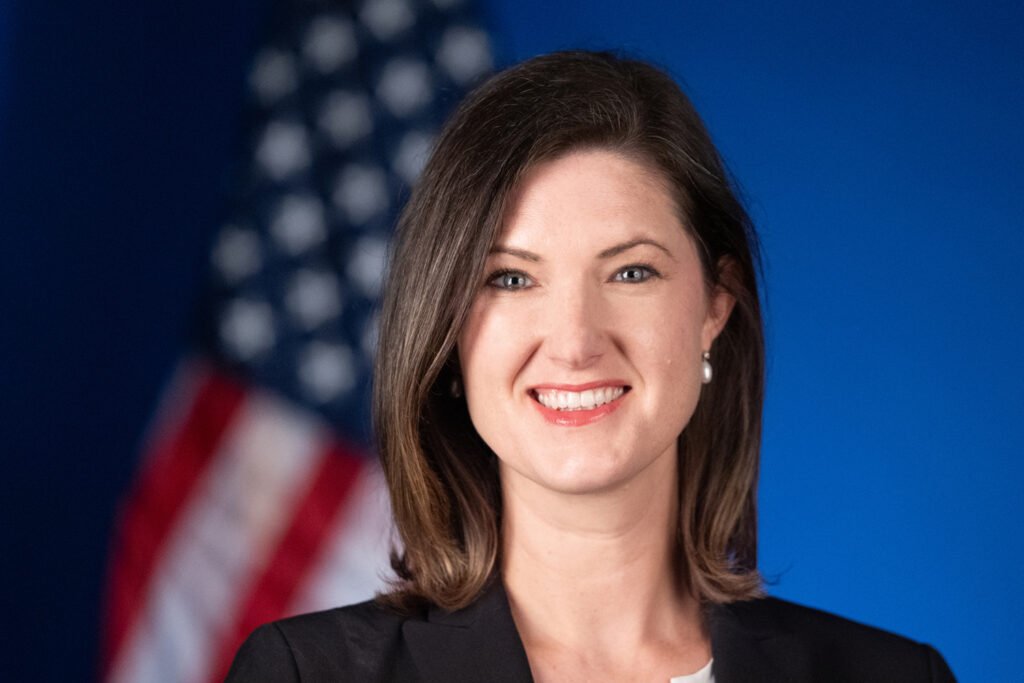
Alexandria, VA - August 29, 2024 - Portrait of Katherine Hiner at the United States Patent and Trademark Office (USPTO). (Photo by Michael Connor/USPTO)
By Mutiu Olawuyi
African creators can turn music, film, fashion and digital content into stronger engines of jobs, exports and investment if governments strengthen intellectual property laws, enforcement systems and public understanding of copyright, a senior U.S. intellectual property official said Wednesday.
Katherine Hiner, the U.S. Patent and Trademark Office’s Intellectual Property Attaché for Sub-Saharan Africa, made the remarks during a digital press briefing hosted by the U.S. Department of State’s Africa Regional Media Hub. The briefing focused on Africa’s creative economy and how intellectual property protections can support creativity, investment and economic opportunity.
Hiner said the discussion formed part of IP for Growth, a year-long U.S. government initiative designed to show how strong intellectual property protection and enforcement can empower Africa’s creative industries. The initiative began in Geneva and continued through workshops in Lagos and Johannesburg, bringing together policymakers, artists, creators, producers, industry executives and entertainment lawyers.
“The creative economy is growing and changing rapidly, and there’s an insatiable appetite for African music worldwide,” Hiner said, noting that the goal is to help rights holders participate in and benefit from the global growth of African creative content.
Her central message primarily focuses on picturing African music not only as culture, entertainment or identity, but also as business.
Hiner said Sub-Saharan African music markets have recorded double-digit growth for five consecutive years, adding that intellectual property will be central to future growth if countries invest in the right legal and institutional systems.
Using the United States as an example, she said IP-intensive industries contributed $11.4 trillion to U.S. gross domestic product in 2024, representing 44 percent of total private-sector GDP. Those industries also supported 65.8 million jobs and accounted for more than 80 percent of U.S. commodity export value.
For copyright-intensive industries, including sound recording, motion picture production, software publishing and performing arts, Hiner said workers earned on average 130 percent more than workers in non-IP-intensive industries.
She said African countries need two things to capture similar value: updated intellectual property laws and the political will to implement them.
“This kind of growth requires two key things: up-to-date IP laws on the books and the political will to fully implement them,” Hiner said. She added that governments must invest in administration, enforcement, staff training and dialogue with rights holders.
Hiner further identified several priority reforms, including ratification and implementation of the WIPO Copyright Treaty and the WIPO Performances and Phonograms Treaty, which support digital distribution models such as streaming and downloads. She also emphasized the importance of strengthening Collective Management Organizations, which help artists manage rights and collect revenue through large-scale licensing.
The briefing also addressed a major frustration for African artists: global visibility does not always translate into income.
Hiner said data from the Music Economy Development Initiative showed that in Kenya and Nigeria alone, $286 million in recorded revenue is left uncollected each year. She said the main gaps include weak transparency and accountability in collection systems, limited public awareness and insufficient enforcement resources against piracy.
She warned that piracy should not be treated as harmless, saying it damages creators and can also support organized crime. She cited a recent cross-border enforcement action in which authorities took down 1,000 infringing pirate sites during the World Cup.
The briefing also touched on artificial intelligence and copyright. Hiner said copyright remains central to protecting creative works while supporting innovation in AI technologies. She said legal doctrines such as fair use and fair dealing will play an important role in balancing the rights of creators with the needs of innovators.
For African creators, the discussion points to a practical development challenge. Talent alone is not enough. A thriving creative economy also needs functioning copyright offices, transparent royalty systems, fair contracts, anti-piracy enforcement, digital literacy, and trusted institutions that allow artists to earn from their work.
For Senegal, The Gambia and the wider Senegambia region, the lesson is especially urgent. Music, fashion, film, storytelling, digital media and cultural performance already shape identity and community life. With stronger IP systems, these sectors can also become structured sources of youth employment, women’s enterprise, export revenue and national branding.
But stronger IP protection must not benefit only established artists, foreign companies or major labels. It must also serve young creators in neighborhoods, community studios, schools, local fashion houses and digital platforms. That requires accessible registration systems, creator education in local languages, affordable legal support and fair royalty collection.
The most meaningful reform will be one that allows African creators to own, protect, license and monetize their work without being excluded by cost, bureaucracy or lack of information.
Hiner’s message was therefore both economic and ethical: creativity has value, and creators deserve systems that protect that value.
Hence, for Africa’s creative economy to grow fairly, governments, industry leaders, platforms, artists and civil society must now move from inspiration to implementation.
About The Author