Senegal raises petrol, diesel prices as subsidy costs mount
By Mutiu Olawuyi
Senegal’s Ministry of Energy and Petroleum has announced an increase in fuel prices, with new rates for petrol and diesel taking effect on Saturday, Aug. 15, 2026, as the government moves to contain rising subsidy costs driven by global oil market pressures.
Under the new price structure, super petrol will rise to 990 CFA francs per liter, an increase of 70 CFA francs, while diesel will rise to 755 CFA francs per liter, an increase of 75 CFA francs.
The ministry said the adjustment returns automotive fuel prices to the levels that were in force before the price reduction of Dec. 6, 2025.
According to the communiqué, the decision comes in an international context marked by conflict in the Middle East, which has contributed to a significant rise in oil prices. The ministry said that between July 13 and Aug. 15, 2026, real prices for diesel and super petrol increased by 26.6 percent and 12 percent, respectively, compared with the price-structure period of July 18, 2026.
Since the beginning of the conflict, the ministry said the two products had increased by 69 percent and 61 percent, respectively.
The government also pointed to the growing cost of fuel subsidies. It said subsidies in the downstream hydrocarbon sector alone have been estimated at more than 245 billion CFA francs since the beginning of the year.
Without the latest adjustment, the ministry said cumulative subsidies supported by the supply chain would have reached about 47.27 billion CFA francs for the period from Aug. 15 to Sept. 12, 2026.
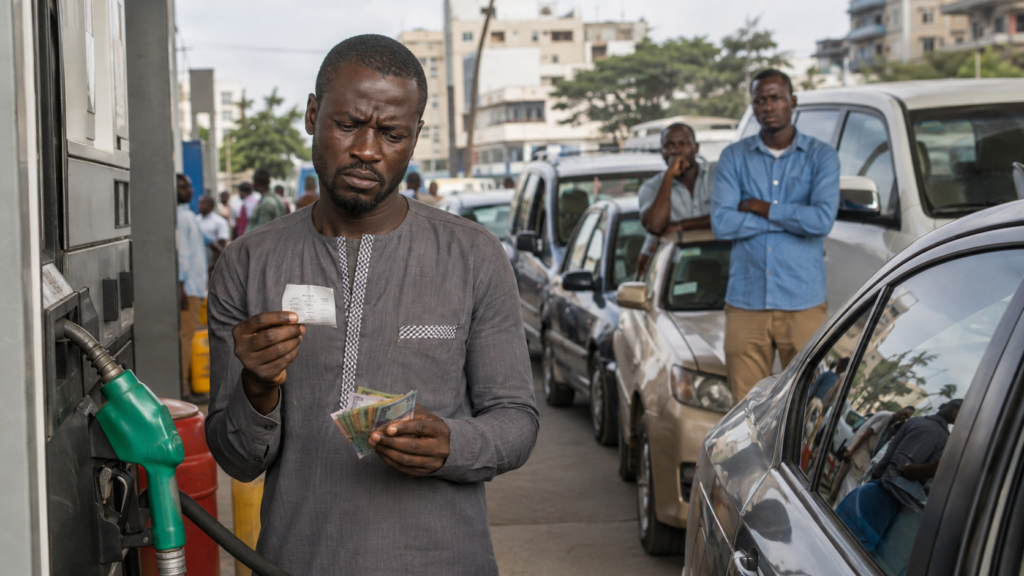
The announcement is likely to affect households, transport operators, traders and small businesses, as fuel prices often influence transport fares, food distribution costs and the general cost of living.
For many Senegalese families already managing tight budgets, any rise in fuel prices can quickly become a rise in market prices, school transport costs and daily commuting expenses. The government’s fiscal concern is real, but so is the pressure on ordinary citizens.
The challenge now is how Senegal manages the adjustment without allowing the burden to fall disproportionately on low-income households, workers, rural producers and informal-sector businesses.
Fuel subsidies can protect consumers in the short term, but they also place heavy pressure on public finances when global prices rise sharply. At the same time, removing or reducing subsidy support without targeted relief can deepen hardship for people who already spend a large share of their income on transport, food and energy.
The government should therefore accompany the price increase with clear public communication, stronger monitoring of transport and market prices, and targeted measures to protect vulnerable households.
Transport unions, consumer associations, fuel distributors and local authorities should also be engaged quickly to prevent speculation, unjustified fare increases and panic buying.
The measure also underlines the need for Senegal to accelerate longer-term energy resilience. Diversifying energy sources, improving public transport, investing in renewable energy and strengthening domestic energy planning can reduce exposure to external oil shocks over time.
The ministry’s communiqué appears to include a date inconsistency in one circulated version referring to “February 2026,” but the substance of the announcement states that the fuel price adjustment takes effect on Aug. 15, 2026.
For Senegal, the fuel increase is not only an economic decision. It is a social test. The government must balance fiscal responsibility with protection for citizens whose daily lives are directly affected by the price of fuel.
About The Author