U.S. skateboarding program closes in Dakar ahead of 2026, 2028 Olympics
By Mutiu Olawuyi
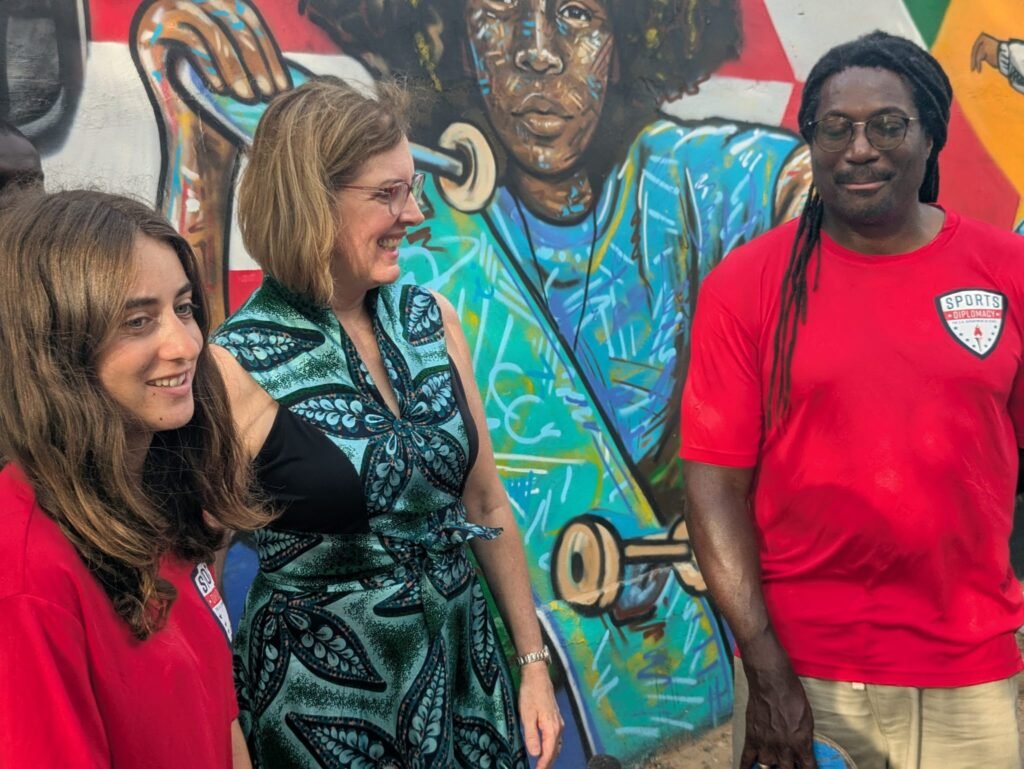
On Saturday afternoon at Patte-d’Oie Skate Park, U.S. and Senegalese officials closed out a week-long skateboarding exchange program timed to a moment organizers called historic: the Olympic flame’s arrival in Dakar ahead of the 2026 Youth Olympic Games, the first Olympic sporting event ever held on African soil.
The closing ceremony drew Dakar’s mayor and the mayors of Grand Yoff and Thiès, the president of the Senegalese National Olympic and Sports Committee, the president of the Organizing Committee of the Youth Olympic Games, and the president of the Senegalese Roller-Skate Federation, alongside coaches, athletes and members of Dakar’s skateboarding community.
“This program unites the United States and Senegal, and shows once again the strength of our sporting partnership,” Jennifer Davis Paguada, Chargé d’Affaires of the U.S. Embassy in Senegal, told the gathering, thanking Senegal’s Minister of Youth and Sports and the officials who made the week possible.
Over the course of the week, in both Dakar and Thiès, Dr. Neftalie Williams, the first U.S. Sports Ambassador for Skateboarding, and Olympic skateboarder Minna Stess worked directly with athletes and coaches from the Roller-Skate Federation, passing on technique, safety fundamentals and, as Paguada put it, “the confidence needed to properly practice skateboarding.”
A sport built on falling and getting back up
 “For those who did not know, modern skateboarding comes from the United States,” Paguada told the crowd. Some trace its roots to 1950s California, she said, when surfers looking to recreate the feeling of riding waves on dry land turned a simple idea into a sport now practiced worldwide, as much an art form and a means of personal expression as a competition.
But she was careful to note that the sport had not arrived in Senegal as something foreign to it. “As in the United States, skateboarding culture in Senegal has encouraged creativity, perseverance and community spirit among athletes,” Paguada said. “Every skater knows that to progress in this sport, you must first try, then fall, get back up, and start again”, a resilience, she added, that was on full display among the young Senegalese who took part this week.
Building something that lasts
In an exclusive interview with Senegambia Times after the ceremony, Olawuyi asked Paguada whether the week marked a one-time gesture or the start of something ongoing.
“We are incredibly proud of this program and of the opportunity to bring such talented and generous athletes from the United States here,” she said. “We are always looking for new opportunities to partner with our Senegalese counterparts, who are incredible partners.” She said the embassy intends to keep building around the Youth Olympic Games, including bringing a delegation of American youth to Dakar for further cultural exchange.
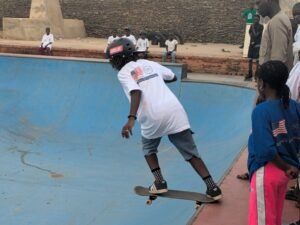 For Williams, on his first trip to Senegal, the week reinforced how quickly enthusiasm turns into skill when given the chance. “The people have been fantastic, and all the coaches have been so eager to learn, as have all the students, many of whom were already skating,” he said. “We had a good number who came in with real skills, and others who just wanted to come out, be taught, and get excited about skateboarding.” He added that he hoped the week had been as inspiring for the students as it was for him and Stess.
Asked what he would say to young Africans who feel apprehensive about the sport, Williams didn’t hesitate. “There’s no reason to be afraid of skateboarding,” he said. “If you can physically walk up a set of stairs, you’re able to step on a skateboard. What skateboarding gives you is a sense of freedom, and everyone should have the time and space to experience that. No need to be afraid — just step on and go.”
Stess, who said she had never coached this many young athletes at once, described the language gap with her Francophone trainees as real but never insurmountable. “The language barrier was definitely hard at first, but they asked really good questions,” she said. “We had excellent translators with us, so they were able to carry my skateboarding techniques and terminology into their own language. It ended up working out — they learned how to skate, and I got to help them with tricks.”
What stayed with her, she said, was simpler than any trick. “I could tell that they were genuinely happy just to be skating. It made the whole experience feel great, and I had a really good time.”
A mural, and a message
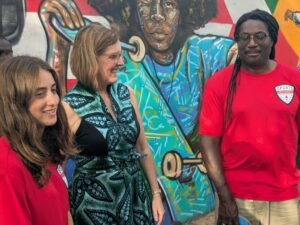
The ceremony closed with the unveiling of a mural commemorating the U.S.-Senegal sporting partnership, painted by Senegalese street artists Mamadou Niang, known as JAHBLOW, and Nathaniel Antonio Rosene Ovelar, known as CECE. Paguada called the piece “a visible reminder of the power of sport,” meant to outlast the ceremony itself. “Sport brings people together,” she said, “and transforms individual talent into collective pride.”
She left the young athletes with a direct challenge. “Perhaps some of you will represent Senegal at the 2028 Olympic Games in Los Angeles,” she said. “Who knows?” The United States, she said, remains committed to working with Senegal to grow the sport and expand opportunities for its youth — and she encouraged the skaters gathered to keep training, “dream big, and advance, whatever obstacles lie in your path.”
About The Author