Faye, Merz move to deepen Senegal-Germany partnership
By Mutiu Olawuyi
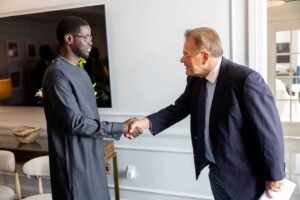
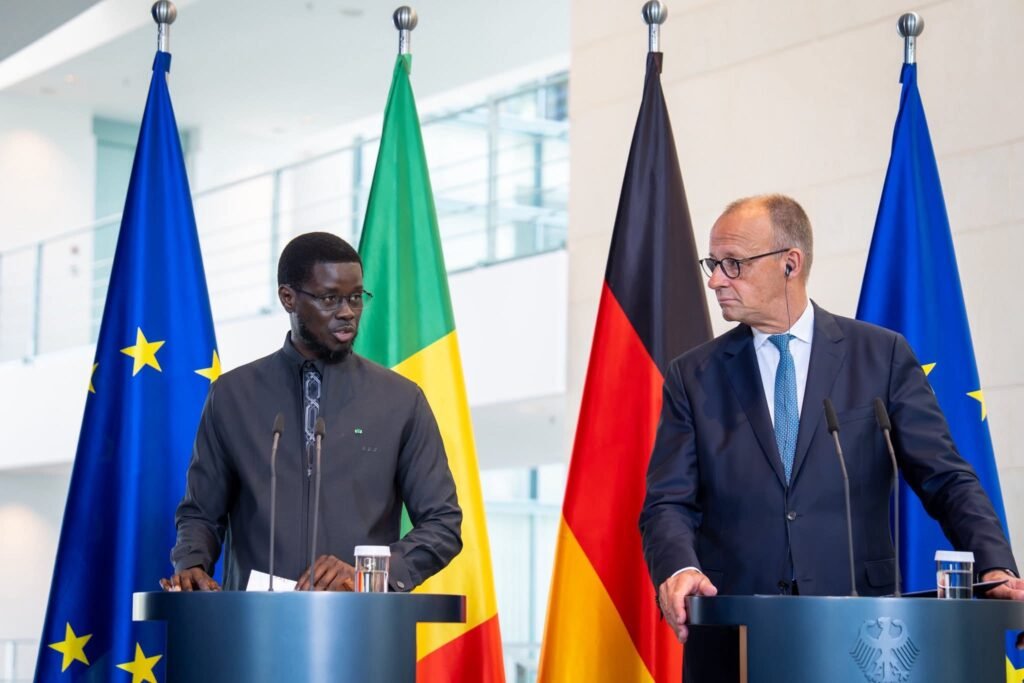
Senegalese President Bassirou Diomaye Faye met Tuesday, June 23, 2026, in Berlin with German Federal Chancellor Friedrich Merz, as both leaders moved to strengthen the long-standing partnership between Senegal and Germany.
The meeting came during President Faye’s visit to Germany and followed the German-Senegalese Economic Day, where several agreements and investment commitments were announced in areas including green transformation, health technology, youth training, cold storage and rural electrification.
During the talks, Faye and Merz hailed the strength of relations between the two countries, describing the partnership as one built on cordial friendship, mutual esteem and high-level exchanges dating back to the early years of Senegal’s independence.
President Faye recalled Germany’s continued support for Senegal’s development efforts across several strategic sectors, including hydraulics, transport, health, education, vocational training, justice and energy. He also noted Germany’s role as Senegal’s leading bilateral partner during the COVID-19 pandemic, a period that tested the strength and reliability of international partnerships.
The meeting confirmed both countries’ intention to deepen economic cooperation. According to the Senegalese presidency, the discussion reflected the momentum created by agreements reached the previous day during the German-Senegalese Economic Day, as well as growing interest from German companies in investing in Senegal.
President Faye reaffirmed that Senegal remains a safe and attractive destination for investors. He called for the partnership to be consolidated and diversified in line with the priorities of Vision Senegal 2050, the country’s long-term development framework focused on energy, infrastructure, agro-industry, health, digital transformation and manufacturing.
For Senegal, the Berlin meeting was more than a diplomatic courtesy. It was part of a wider economic diplomacy strategy aimed at turning political trust into investment, technology transfer, skills development and jobs.
The relationship with Germany is especially important because it connects Senegal’s development ambitions with German expertise in engineering, energy, industry, vocational training, health systems and infrastructure. If managed well, this partnership can support projects that directly affect ordinary citizens — from rural electrification and health equipment to technical training and productive employment for young people.
The two leaders also exchanged views on African and global challenges. President Faye emphasized the importance of continued support for Senegal and the wider region in the fight against terrorism in the Sahel, where insecurity continues to threaten stability, economic development and the safety of communities.
Faye also reaffirmed Senegal’s commitment to the peaceful settlement of disputes through dialogue. He advocated for a more open and inclusive system of global governance, reflecting the concerns of many African countries that current international decision-making structures do not sufficiently represent the priorities and voices of the Global South.
The discussion on global governance is significant. For Senegal and other African nations, development is no longer only about receiving aid or signing bilateral agreements. It is also about gaining fair representation, equitable access to finance, respect for sovereignty and meaningful participation in shaping global rules.
The meeting between Faye and Merz therefore brought together three layers of partnership: historical friendship, economic cooperation and shared diplomatic engagement on global issues.
At the end of the talks, President Faye invited Chancellor Merz to make an official visit to Senegal. Such a visit would mark another step in a partnership both countries say they intend to elevate.
For Senegal, the real test of the Germany engagement will be implementation. Agreements must move from conference rooms in Berlin to visible results in Senegalese communities. Investment must create jobs. Training must reach young people. Energy projects must reach villages. Health partnerships must improve hospitals. Economic diplomacy must improve daily life.
The Berlin meeting gave Senegal and Germany a renewed platform. What comes next will determine whether that platform becomes a bridge to deeper transformation.
About The Author