Senegal secures German support for SMEs, health and rural power
By Mutiu Olawuyi
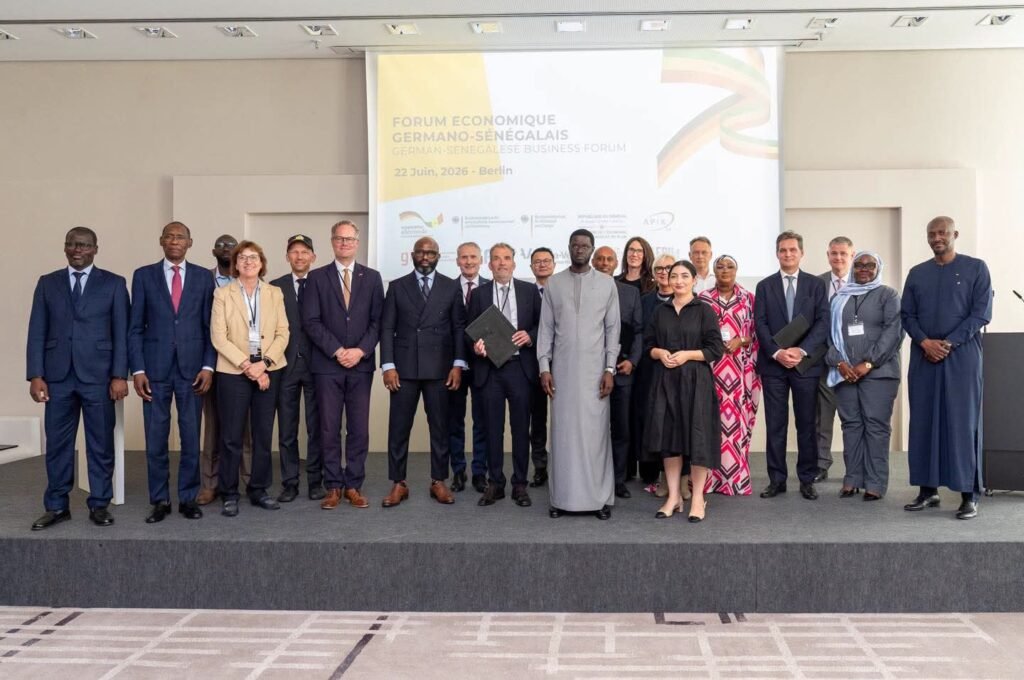
President Bassirou Diomaye Faye has closed the German-Senegalese Day of Economy with a package of investment commitments aimed at strengthening Senegal’s green transition, health sector, youth employment, electricity access, agro-industry and industrial capacity.
The economic gathering brought together businesses from Senegal and Germany for a day of high-level engagement, business dialogue and partnership-building. According to the presidency, the encounter produced specific commitments that are expected to support Senegal’s development priorities under Vision Senegal 2050.
Among the key outcomes was a €20 million envelope from KfW to support the green transformation of Senegalese small and medium-sized enterprises. The support is expected to help local businesses adapt to cleaner production methods, improve competitiveness and participate more actively in Senegal’s climate-conscious economic transition.
The engagements also included a local production project for dialysis equipment with B. Braun, a German medical technology company. The project is expected to promote technology transfer and create skilled jobs, while strengthening Senegal’s capacity to respond to growing health needs.
For patients and families, local production of dialysis-related equipment could become more than an industrial achievement. It could mean improved access, reduced dependence on external supply chains and a stronger health system capable of serving people with chronic kidney disease more reliably.
 Another agreement focused on training young Senegalese in automotive trades with Daimler Trucks. This initiative is expected to support technical skills development and prepare young people for employment opportunities in mechanics, vehicle maintenance, transport technology and related industrial services.
The discussions also included plans to establish a local network of electric utility vehicles, reflecting Senegal’s ambition to connect transport modernization with clean energy, local services and job creation.
A major €100 million program dedicated to cold storage was also announced. The program is aimed at reducing post-harvest losses and creating several thousand jobs. This is particularly important for farmers, fishers, traders and food processors whose incomes are often weakened by poor storage, weak logistics and avoidable waste after harvest.
 Cold storage is not only an infrastructure issue. It is a food security issue, an income protection issue and a rural development issue. When harvests are lost because products cannot be preserved, farmers lose income, consumers face unstable supply and the national economy loses value that could have been retained locally.
In the coming days, the agreements are expected to be followed by the signing, in the presence of the Minister of Finance, of €120 million in funding from GAUFF and ASER. The financing is aimed at expanding electricity access from 300 to 750 villages, a move that could significantly improve rural livelihoods, education, health services, small businesses and local production.
For many rural communities, electricity is not a luxury. It determines whether students can study at night, health posts can preserve medicines, women can run income-generating activities, farmers can process products locally and young people can imagine opportunities without leaving their communities.
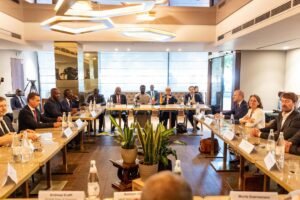
After the closing ceremony, President Faye joined the Africa Business Hub, where he held extended discussions with executives of several of Germany’s largest companies. He invited them to invest in Senegal and presented the foundations of Vision Senegal 2050, which plans to mobilize nearly €28 billion in investments over five years across energy, infrastructure, agro-industry, health, digital technology and manufacturing.
 The president emphasized the guarantees now being offered to investors. According to the presidency, Senegal’s new Investment Code ensures equal treatment between domestic and foreign operators and protection against expropriation. Tax reform is also expected to provide a simplified and more predictable framework, while the digitization of procedures is intended to reduce administrative delays.
These reforms are central to Senegal’s effort to position itself as a stable and competitive investment destination. For investors, predictability matters. For citizens, however, the more important question is whether investment will produce jobs, services, technology transfer and local value.
The meaning of the Berlin engagements is therefore clear: Senegal is seeking partnerships that go beyond announcements and diplomatic symbolism. It is looking for capital, technology and expertise that can translate into visible improvements in people’s lives.
The sectors targeted during the German-Senegalese Day of Economy speak directly to national needs. Green financing can help SMEs modernize. Dialysis equipment production can strengthen health sovereignty. Automotive training can prepare young people for skilled jobs. Electric utility vehicles can support cleaner transport. Cold storage can protect harvests. Rural electrification can open new possibilities for villages.
 For Senegal, the challenge will be implementation. Large financing envelopes and corporate commitments must be followed by transparent execution, local participation, skills transfer, fair access and measurable impact. Development partnerships become meaningful only when they reach workshops, farms, hospitals, villages, training centers and households.
Germany’s role in the partnership is also significant. German companies bring technology, engineering capacity, industrial expertise and capital. Senegal brings stability, reform ambition, natural resources, human capital and a strategic location in West Africa.
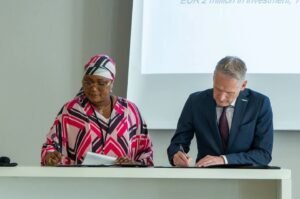 The presidency described the complementarity as the foundation for structural projects that should ultimately benefit populations. That is the real test. Agreements signed in Europe must become jobs in Senegal. Investment discussions must become electricity in villages. Industrial partnerships must become skills in the hands of young people. Health technology must become care for patients.
The German-Senegalese Day of Economy therefore stands as an important step in Senegal’s economic diplomacy. It reflects a development strategy built around partnership, reform and national transformation.
If the commitments are implemented with accountability and a strong focus on citizens, the Berlin engagements could help Senegal move closer to an economy that produces more locally, stores more of what it harvests, trains more of its youth, powers more villages and treats more patients with dignity.
About The Author