Ziguinchor receives equipment to enroll persons with disabilities

By Mutiu Olawuyi
The Regional Directorate of Social Action in Ziguinchor has received equipment to support the enrollment of persons with disabilities under PAPCEC 2026, a national initiative aimed at accelerating access to the Carte d’Égalité des Chances and strengthening social inclusion across Senegal.
The equipment was received by the Direction régionale de l’Action sociale, known as DRAS Ziguinchor, led by Nourou Thiam, as part of efforts to improve registration, documentation and proximity services for persons living with disabilities in the region.

The initiative falls under the wider social inclusion agenda of Senegal’s Ministry of Family, Social Action and Solidarity, with national and regional social action authorities working to ensure that persons with disabilities are better identified, documented and connected to public services.
The program is overseen at the national level by Boucar Diouf, Director General of Social Action, and is being implemented in coordination with regional authorities, including Governor Mortalla Tune.
In Ziguinchor, the regional rollout is expected to strengthen the work of local social action officers and improve access for persons with disabilities who may face mobility challenges, transport costs or difficulty reaching administrative services.
According to officials, the equipment will help expand enrollment capacity, improve efficiency and bring services closer to communities, particularly in rural and hard-to-reach areas.
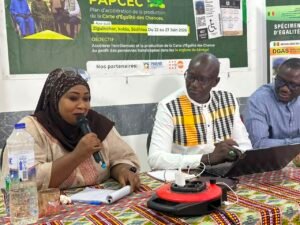 In an exclusive interview with Senegambia Times, Anta Ndiaye, a senior staff member at the Ministry of Family, Social Action and Solidarity, emphasized the importance of the new equipment in improving outreach and service delivery.
“This equipment will significantly improve our ability to reach persons with disabilities across the region, especially those who face mobility challenges or live far from administrative centers,” Ndiaye said. “Our goal is to ensure that no one is left behind in accessing the Carte d’Égalité des Chances and the services it unlocks.”
The PAPCEC 2026 campaign is designed to accelerate access to the Carte d’Égalité des Chances, a document intended to help persons with disabilities benefit from social support, public services and programs linked to inclusion.
For persons with disabilities in Ziguinchor, the arrival of the equipment is more than a technical development. Enrollment can determine whether a person is counted, recognized and considered in public programs. Without reliable registration, many persons with disabilities remain outside the systems meant to support them.
 Authorities note that disability inclusion begins with accurate information. Reliable data is essential to understand the scale of needs, identify service gaps and guide policies on assistive devices, inclusive education, vocational training and social assistance.
The PAPCEC 2026 process also addresses the daily challenges faced by families. Without proper registration, children with disabilities may miss out on educational support, while adults may remain excluded from employment programs, social assistance or access to assistive equipment.
Local social workers involved in community outreach stress the importance of awareness, patience and clear communication to ensure that families understand the process and feel encouraged to participate.
The receipt of equipment by DRAS Ziguinchor is therefore a positive step, but its success will depend on effective implementation. The tools must be used to expand coverage, speed up registration, protect personal data and connect registered persons with meaningful services.
 The campaign must also ensure that outreach extends beyond administrative centers to rural communities and vulnerable households. Collaboration between local authorities, disability associations and community leaders will be essential to achieving this goal.
The process must respect dignity. Persons with disabilities should be treated as rights holders whose full participation strengthens society.
For Ziguinchor, PAPCEC 2026 provides an opportunity to make inclusion visible and practical. If properly implemented, the enrollment drive can help families access support, improve public planning and strengthen the connection between vulnerable citizens and the institutions meant to serve them.
For persons with disabilities, the promise of PAPCEC 2026 will be measured not only by equipment delivered, but by doors opened: access to assistance, inclusive education, skills training, health support, economic opportunity and full participation in community life.
About The Author