U.S. Startup Symphony Space signs agreement with Senegal Space Agency at Senegal Space Week
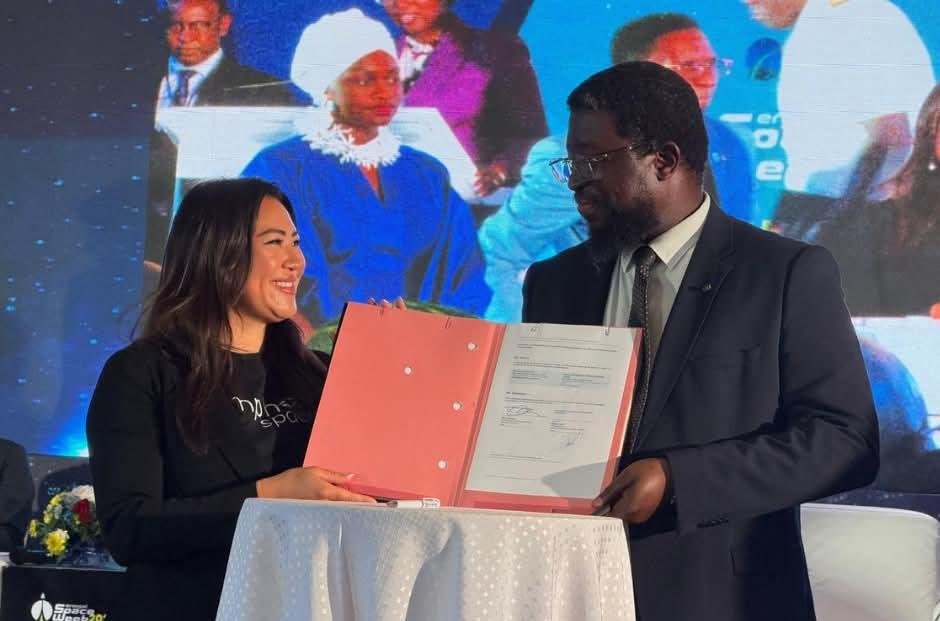
The protocol of agreement highlights how American space innovation and Senegal’s emerging space ambitions can meet through trade diplomacy, technology transfer and practical satellite solutions.
By Mutiu Olawuyi
The momentum around Senegal Space Week gained another international partnership boost as the American company Symphony Space signed a protocol of agreement with the Senegalese Space Agency, following an opening speech at the high-level space-sector gathering.
The agreement places attention on Adagio, Symphony Space’s plug-and-play space platform designed to help clients deploy and upgrade satellite instruments without the cost and complexity of building fully customized spacecraft for every mission.
For Senegal, the partnership signals a practical opportunity to expand access to space technology while managing the financial and technical barriers that often limit emerging space nations. For the United States, it demonstrates how private-sector innovation can complement diplomatic engagement and open new markets for American startups.
Symphony Space describes Adagio as a shared, reusable “Space-as-a-Service” platform intended to reduce the cost and timeline of operating in orbit. The company says its model replaces expensive bespoke spacecraft development with modular infrastructure, offering a more affordable route for payload hosting and orbital operations. �
Symphony Space
The protocol signed at Senegal Space Week therefore reflects a wider shift in the global space economy. Instead of space access being limited to major powers and heavily funded agencies, newer models now allow countries, research institutions and startups to participate through hosted payloads, modular systems and commercial partnerships.
This matters for Senegal because the country has been building a clearer national space agenda through the Senegalese Agency for Space Studies. Senegal Space Week 2026 has brought together international experts, agencies, researchers, investors, government representatives, scientists and security actors to discuss how space can support development, sovereignty and structural transformation. �
Le Soleil
The agreement also fits within the broader context of Senegal’s growing role in international space diplomacy. In July 2025, Senegal signed the Artemis Accords, becoming part of a U.S.-led international framework that promotes responsible, transparent and sustainable cooperation in space exploration. NASA described Senegal as the 56th country to sign the Accords. �
NASA
From a constructive development perspective, the Symphony Space–Senegal Space Agency agreement should be viewed not only as a technology announcement, but also as a test of implementation. If carefully managed, such partnerships can support satellite-based applications in agriculture, climate monitoring, maritime security, disaster response, land management, research and telecommunications.
The deeper value will depend on whether the agreement leads to local capacity-building. Senegal’s space ambition will be stronger if international partnerships include training for Senegalese engineers, opportunities for local researchers, participation by universities, collaboration with startups and clear pathways for Senegalese institutions to operate and interpret space-derived data.
For American companies, the partnership presents a business opportunity in a fast-emerging African technology market. For Senegal, it offers a chance to negotiate access to advanced tools without losing sight of sovereignty, affordability and long-term human capital development.
This is the promise of effective trade diplomacy: investment and innovation should not move in only one direction. They should create shared benefit, allowing American startups to expand responsibly while helping Senegal build the technical foundation required to compete in the space economy.
As Senegal continues to position itself as an emerging African space actor, the Symphony Space agreement offers a clear message: space development is no longer only about launching satellites. It is about building ecosystems, training people, protecting national interests and turning technology into practical solutions for citizens.
About The Author