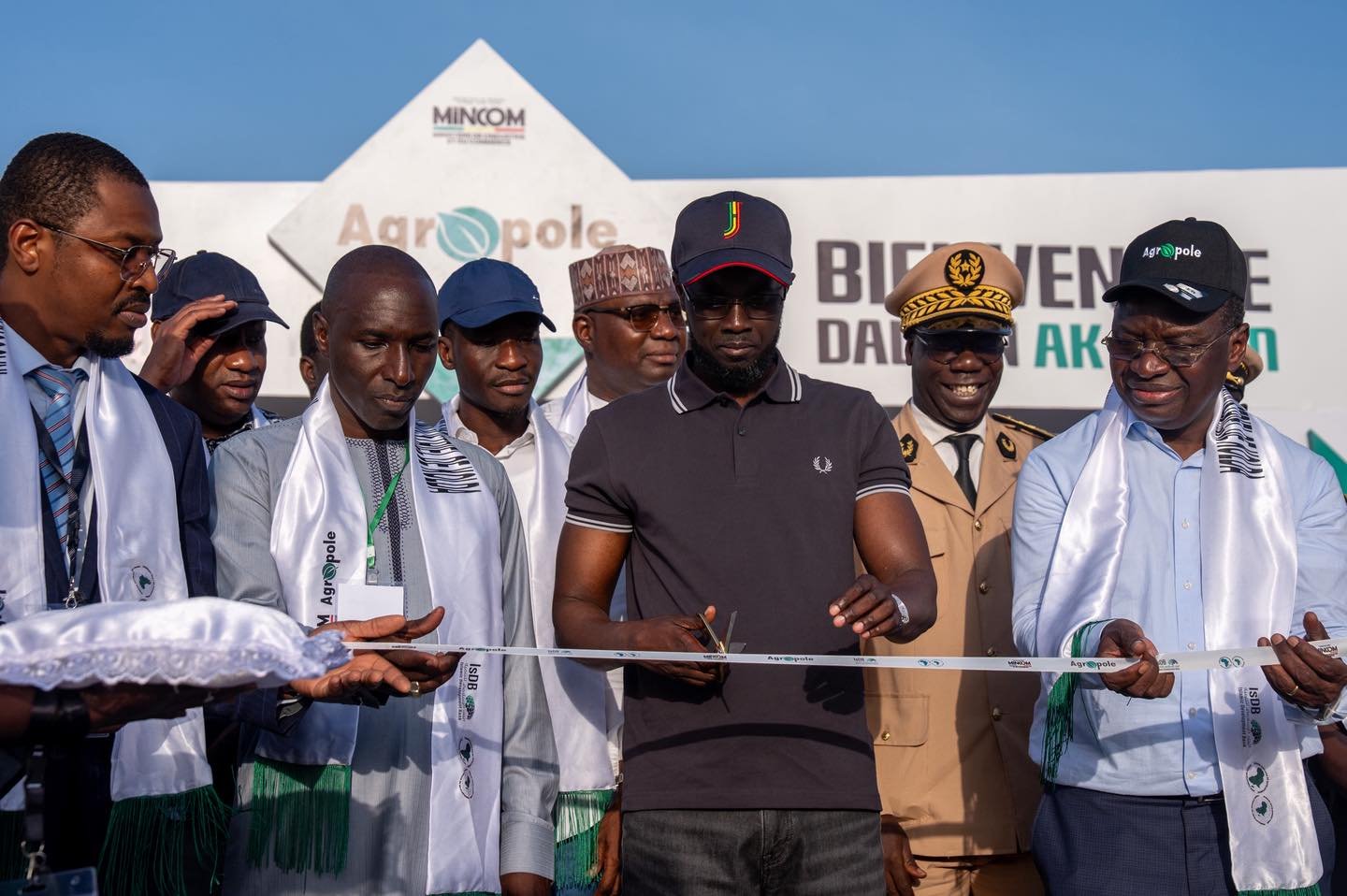
President Bassirou Diomaye Faye has inaugurated the Kolda Agro-Industrial Park, presenting it as a strategic pillar in Senegal’s effort to deepen agro-industrial transformation, expand regional value creation, and rebalance development beyond the capital. The park is part of the wider Agropole Sud programme, which covers Ziguinchor, Kolda, and Sédhiou under Senegal’s national agropole development strategy.
Located in the municipality of Dioulacolon, the Kolda site covers 15 hectares, with 5 hectares already developed, according to the project description provided by Senegalese agropole authorities. The facility is being developed under the supervision of the Ministry of Industry and Commerce and financed by the Islamic Development Bank.
The infrastructure is designed to do more than process crops. Project documents describe a system meant to improve the entire chain of agricultural value creation: storage, cold preservation, logistics, transformation, and business incubation. Across Agropole Sud, authorities expect the programme to generate around 14,500 direct jobs and 35,000 indirect jobs, while supporting private investment and stronger agro-food competitiveness in southern Senegal.
That larger ambition matters. Senegal’s agropole strategy is not simply about building industrial sites; it is about reducing territorial imbalance by placing productive infrastructure closer to farming zones and regional markets. The national agropole programme says its core goals include industrial redeployment, balanced territorial development, food sovereignty, and stronger private-sector participation in local transformation.
 For Kolda and the wider south, this means the park could become more than an industrial installation. It could serve as a bridge between local production and higher-value markets, allowing producers, cooperatives, SMEs, and processors to move from selling raw output to creating finished or better-preserved products with stronger commercial value. That shift is essential if agricultural regions are to retain more wealth, create more jobs, and reduce dependence on distant processing centers.
Agropole Sud as a whole includes nine agro-industrial parks distributed across the southern pole, with Kolda identified as one of the regional modules in the programme. Official project material says the broader system aims to raise transformation rates in products such as mango, cashew, and maize, while unlocking more resilient local industrial ecosystems.
The inauguration therefore carries both practical and symbolic weight. Practically, it gives the south new infrastructure for storage, processing, and enterprise development. Symbolically, it reflects a development philosophy that sees regional production not as a peripheral activity, but as a national strategic asset.
The real test, however, will come after the ceremony. Infrastructure creates potential, but long-term success will depend on efficient management, private-sector uptake, access for local entrepreneurs, reliable utility services, and the ability to connect the park’s operations to real agricultural and commercial demand.
Still, the Kolda Agro-Industrial Park represents a significant step in Senegal’s attempt to build a more regionally balanced economy — one in which local production generates local value, and where industrial growth is not confined to Dakar alone.