American Inventions and the Lessons They Still Offer the World
By Mutiu Olawuyi
The United States is not only a major political and economic power. It is also one of history’s most consequential engines of invention. To understand America seriously, one must look beyond elections, wars, and cultural exports and pay close attention to its repeated ability to turn imagination into tools that transform everyday life. Again and again, it has taken problems once accepted as permanent and forced the world to rethink what is possible. That inventive tradition is one of the clearest reasons America continues to matter globally.
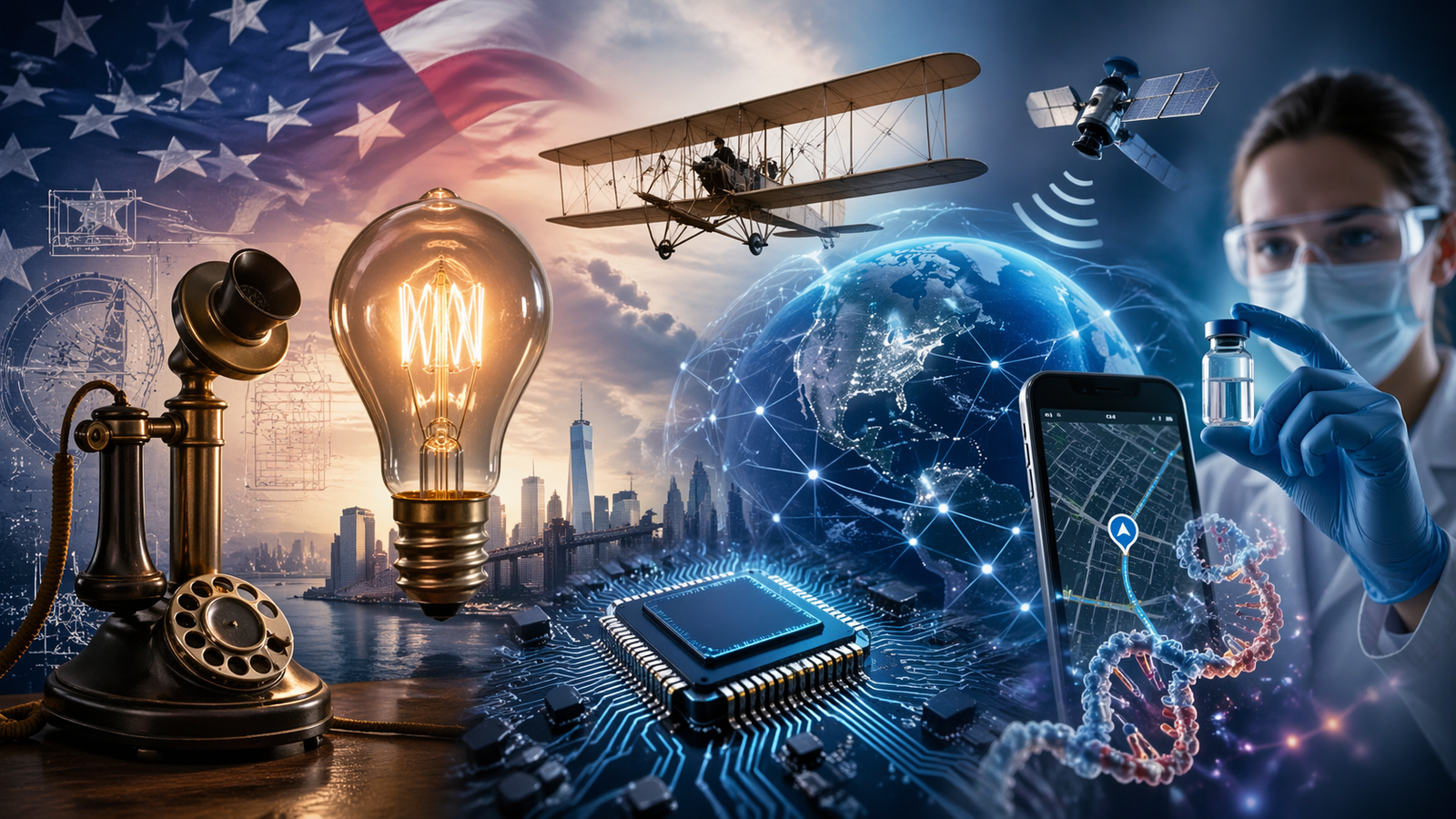
Consider the telephone. In 1876, Alexander Graham Bell secured the key patent and successfully demonstrated a device for transmitting vocal sounds electrically. Days later, on March 10, 1876, Bell made the now-famous first telephone call to his assistant, Thomas Watson. The telephone did not simply improve communication; it changed business, family life, emergency response, diplomacy, and journalism. It made the world more immediate and reduced the tyranny of distance.
Then came practical electric light. In 1879, Thomas Edison and his team produced a long-lasting incandescent lamp practical enough for widespread use. Others had worked on electric lighting before him, but Edison’s breakthrough was to make it durable and commercially usable at scale. With practical electric lighting, modern life was extended into the night. Productivity changed. Education changed. Urban life changed. Homes, industries, and public spaces were reorganized by a new command over darkness.
Then the United States helped unlock the sky. On December 17, 1903, at 10:35 a.m. in Kitty Hawk, Orville and Wilbur Wright achieved the first powered flight of a heavier-than-air machine, with crucial mechanical help from Charles Taylor, who built the engine. The first flight lasted 12 seconds and covered 120 feet. That was not a stunt. It was the beginning of the aviation age. The airplane changed trade, migration, warfare, rescue operations, diplomacy, and imagination itself.
The 20th century then accelerated America’s inventive authority through electronics. In 1947, at Bell Labs in New Jersey, John Bardeen, Walter Brattain, and William Shockley produced the transistor. That breakthrough laid the basis for the communications and computer revolution. Without the transistor, there would be no modern chip economy, no smartphone culture, no personal computing age, and no digital infrastructure as we now know it. The transistor was small in size, but historic in consequence.
From there came the age of the internet. The timeline matters. ARPANET began in 1969 as an American networking experiment backed by the U.S. Department of Defense. In the 1970s, Vint Cerf and Bob Kahn developed the core TCP/IP protocols that made internetworking possible. Over time, American public research institutions, especially the National Science Foundation, helped expand networked computing beyond defense and academia into broader civilian use. The internet did not merely create websites. It created a new nervous system for civilization — changing communication, finance, education, media, commerce, and politics.
The same pattern continued in navigation. GPS did not appear overnight. Its roots stretch back to the Sputnik era, when scientists realized that radio signals from satellites could be tracked and used for positioning. U.S. Navy satellite-navigation experiments advanced in the mid-1960s, and over time the United States developed what became the Global Positioning System — now a U.S. government-owned, Air Force-operated radio-navigation system available worldwide. The modern GPS story also includes major American contributors such as Roger Easton, Ivan Getting, and Bradford Parkinson, whose work is widely associated with its development. Today, GPS supports aviation, shipping, logistics, agriculture, mapping, emergency response, and daily urban life. It is one of those inventions so integrated into modern living that people notice it most only when it fails.
More recently, the role of American science became even more visible through mRNA vaccine technology. The timeline here is important as well. The scientific groundwork stretches back decades, long before COVID-19. NIH-supported researchers spent years tackling the technical barriers that made mRNA fragile and difficult to use safely as a vaccine platform. By the 2010s, scientists at NIAID’s Vaccine Research Center were also studying coronavirus spike proteins, work that later proved crucial. When the COVID-19 pandemic struck, this accumulated research enabled an extraordinarily rapid response. The result was not a miracle pulled from thin air, but the harvest of long-term investment in science. Recent recognition of figures such as Katalin Karikó and Drew Weissman has further underscored how persistent biomedical research can eventually save millions of lives.
These inventions matter not only because they made America strong, but because they made the world more capable. At its best, invention expands human agency. It helps people do what they could not previously do. It enlarges reach, speed, safety, knowledge, or survival. The telephone enlarged connection. Electric light enlarged usable time. The airplane enlarged movement. The transistor enlarged computation. The internet enlarged access. GPS enlarged certainty. mRNA technology enlarged the speed and flexibility of medical response. That is why invention must be judged not only by commercial success, but also by how deeply it serves human progress.
There is an important lesson here for Africa, and especially for countries such as Senegal that are seeking a meaningful place in the future global order. The right response to America’s inventive legacy is neither uncritical admiration nor reflexive suspicion. It is thoughtful learning. The question is not whether one nation has achieved remarkable things. It has. The question is what kind of systems made those achievements possible — and whether others are willing to build similar systems for themselves.
Invention does not flourish in a vacuum. It requires institutions. It requires serious universities, research culture, technical education, funding for experimentation, legal protection for ideas, and a social environment that does not punish failure too harshly. It requires a national willingness to let curiosity become infrastructure. Where these conditions are weak, invention struggles. Where they are strong, possibility multiplies. America’s inventive timeline, from Bell in 1876 to mRNA vaccines in the 2020s, is really a timeline of institutions carrying ideas forward across generations.
That is why developing societies must ask themselves harder questions. Are we building classrooms that produce thinkers, makers, and problem-solvers, or only memorizers? Are we investing in laboratories, engineering, and original research? Are we linking universities to industry? Are we financing the next generation of inventors, coders, scientists, and designers? Are we treating innovation as central to national dignity, or as a luxury to be imported from elsewhere?
The answers to those questions will determine far more than economic growth. They will shape whether future generations merely consume the inventions of others or contribute inventions of their own.
There is also a moral dimension to this conversation. The best inventions do not merely create wealth. They reduce human limitation. They make life more navigable, more survivable, more connected, or more informed. They extend what ordinary people are capable of doing. In that sense, invention is not only an economic act. It is also a humanistic one.
The world should study American invention not because one nation is flawless, but because serious achievement deserves serious study. One can disagree with a country’s policies and still learn from its strengths. One can criticize power without denying ingenuity. One can be rooted in one’s own identity and still recognize that some societies have built systems worth examining carefully.
The future will belong not only to those who consume technology, but to those who create it. That is the deeper lesson. America’s greatest inventions are not merely trophies of the past. They are reminders of what becomes possible when a society organizes itself around curiosity, experimentation, and practical ambition.
The challenge before the rest of the world is not to applaud forever. It is to build.
And that is where the next chapter of global invention must begin.
About The Author