Faye takes over ECOWAS chairmanship from Bio
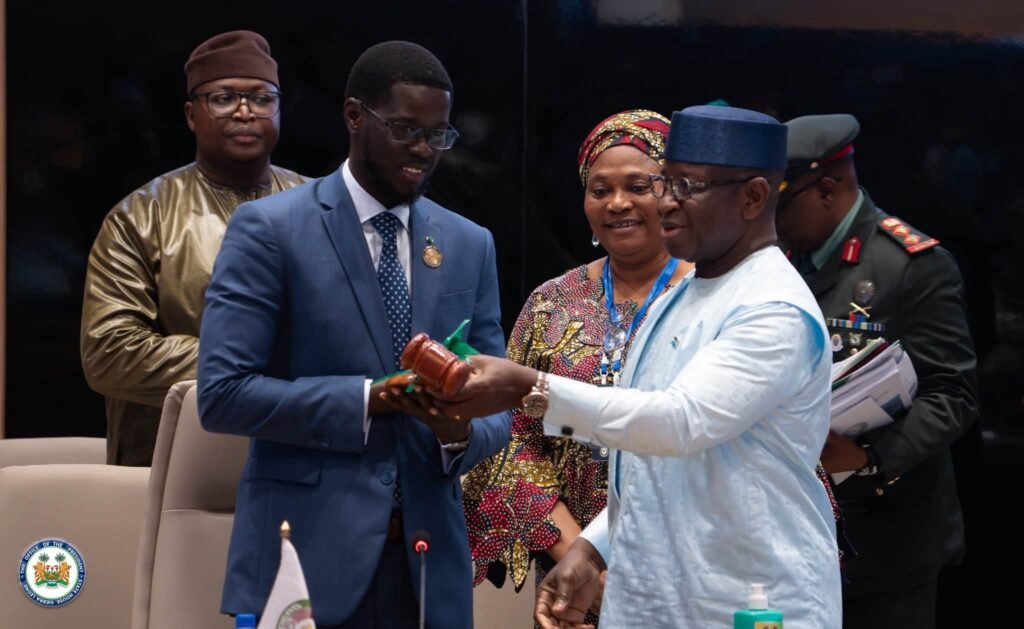
By Mutiu Olawuyi
Sierra Leonean President Julius Maada Bio has announced the handover of the chairmanship of the ECOWAS Authority of Heads of State and Government to Senegalese President Bassirou Diomaye Diakhar Faye, after completing his mandatory one-year term.
In a farewell message, President Bio described his tenure at the head of the regional bloc as a privilege, saying he was pleased to pass the mantle of leadership to President Faye.
“After fulfilling my mandatory one-year term as Chairman of the ECOWAS Authority, I am delighted to pass the mantle of leadership to my younger brother, His Excellency Bassirou Diomaye Diakhar Faye, President of the Republic of Senegal,” Bio said.
He added that leading the West African community through important regional moments had been a profound honor.
“Leading our Community through such defining moments has been a profound privilege,” he said. “As I hand over this responsibility, I extend my best wishes to the incoming Chairman.”
The transition places President Faye at the head of ECOWAS at a time when West Africa continues to face serious political, economic and security challenges. The region is dealing with democratic transitions, military-led governments, violent extremism, youth unemployment, migration pressures, border insecurity, institutional trust deficits and the urgent need for stronger regional economic integration.
For Senegal, Faye’s emergence as ECOWAS chair is diplomatically significant. It gives Dakar a larger regional responsibility at a moment when Senegal itself is undergoing political and institutional change under a new generation of leadership.
The chairmanship will test Faye’s ability to balance national priorities with regional obligations. As ECOWAS chair, he will be expected to help build consensus among member states, strengthen dialogue, defend democratic principles and support policies that respond to the daily concerns of West African citizens.
The handover also carries generational meaning. President Bio’s reference to Faye as his “younger brother” reflects not only diplomatic courtesy, but also the arrival of younger political leadership into major regional responsibility.
For ordinary West Africans, however, leadership changes at ECOWAS matter only when they produce visible results. Citizens across the region want safer communities, easier trade, fairer borders, more jobs, stable food prices, accountable governance and institutions that defend people rather than only governments.
That is the challenge before President Faye.
ECOWAS must not be seen merely as a club of presidents. It must increasingly become a community of people — traders, farmers, students, workers, migrants, women, young entrepreneurs and border communities whose lives depend on regional peace and cooperation.
Faye’s chairmanship therefore comes with both honor and pressure. The honor is that Senegal has been entrusted with regional leadership. The pressure is that West Africa urgently needs practical, credible and people-centered leadership.
President Bio’s handover message was brief, but it pointed to continuity. Regional institutions are strongest when leadership transitions are orderly, respectful and focused on the collective interest.
As President Faye assumes the ECOWAS mantle, the expectation will be for him to lead with humility, firmness and a clear understanding that West Africa’s future depends on cooperation, trust and shared responsibility.
The task ahead is not only to chair meetings. It is to help restore confidence in regionalism and prove that ECOWAS can still be a force for peace, democracy and development in the lives of West Africans.
About The Author