U.S.-backed school feeding program delivers food support to Gambian primary pupils
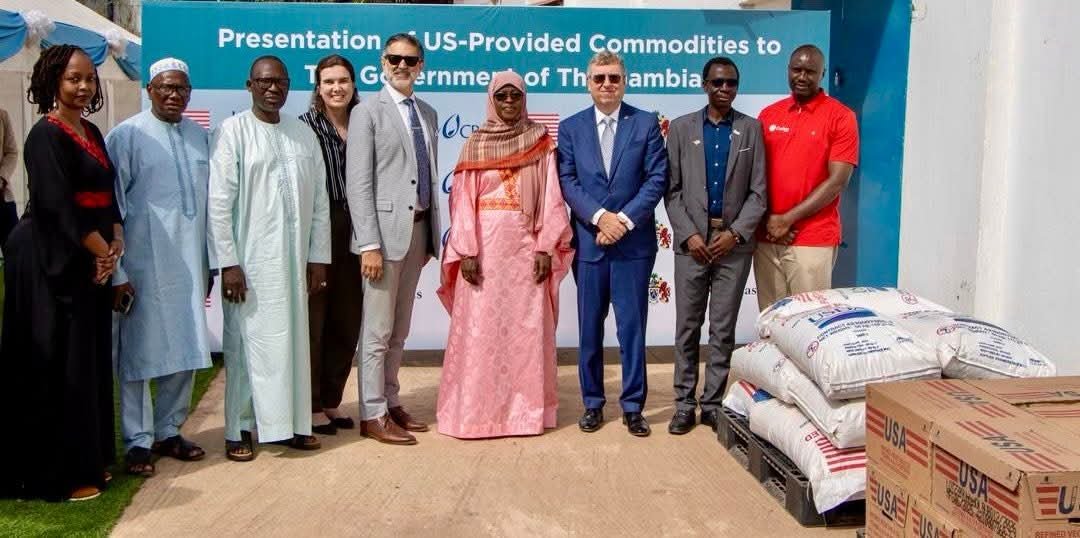
The United States has handed over a new consignment of food commodities to The Gambia’s Ministry of Basic and Secondary Education as part of ongoing support for school feeding, child nutrition, and learning outcomes across the country.
The handover was led by Chargé d’Affaires Eugene Young under the USDA McGovern-Dole International Food for Education and Child Nutrition Program. The event was organized by Catholic Relief Services and its partners, bringing together officials from the U.S. government, the Gambian education sector, and key stakeholders in school feeding.
Among those in attendance were Katelyn Hickey-Schaub, USDA International Program Specialist; Erik Syngle, Regional Agricultural Attaché; and Hon. Dr. Habibatou Drammeh, Minister of Basic and Secondary Education.
The donated commodities include 624 metric tons of fortified rice, 86 metric tons of lentils, and 117 metric tons of fortified vegetable oil. According to the program, the food products were purchased from American farmers and will be used to provide meals for Gambian primary schoolchildren.
 Beyond direct food assistance, the initiative also includes $2 million in local procurement, designed to support Gambian farmers and contribute to long-term economic development. This local procurement component connects school feeding with domestic agriculture, helping strengthen both child nutrition and rural livelihoods.
The program has so far delivered 17.7 million meals to more than 63,000 schoolchildren in The Gambia. Supporters say the intervention has helped improve nutrition, school attendance, and learning conditions for children, particularly in communities where food insecurity can affect education.
For The Gambia, school feeding remains more than a meal program. It is a practical investment in children’s health, classroom participation, family stability, and national development. When children are properly fed, they are more likely to stay in school, concentrate in class, and benefit from the education system.
The partnership between the United States, Catholic Relief Services, the Ministry of Basic and Secondary Education, and local stakeholders reflects a development model that combines humanitarian support with measurable education and nutrition outcomes.
Officials described the initiative as part of a broader commitment to accountable and mutually beneficial foreign assistance, supporting Gambian pupils while also sourcing agricultural commodities from American farmers.
As The Gambia continues to strengthen its education and nutrition systems, the school feeding partnership offers a constructive example of how international cooperation can support children today while investing in healthier, more resilient communities for the future.
About The Author