Talib Bensuda accepts coalition 2026 flagbearer role, calls for national unity

By Ebrima Fadera
Edited by Mutiu Olawuyi
Talib Ahmed Bensuda has accepted the role of Flagbearer of Coalition 2026, describing his selection as a historic responsibility and a victory for national unity above party, personal and sectional interests.
In a statement, Bensuda said the coalition represents the belief that Gambians and political forces with different histories, identities and perspectives can still come together around one national purpose.
“Today, I accept with humility and gratitude the historic responsibility of becoming the Flagbearer of Coalition 2026,” he said. “This is not a victory for one party. It is a victory for the idea that Gambians and political forces with different histories, identities and perspectives can come together around one national purpose.”
 Bensuda thanked the political entities that remain committed to the coalition, naming PASTEF The Gambia, Gambia Sustainable & Environmental Movement, People’s Right Party, Forward Gambia, National Reform Congress, Gambia Movement for Progress, Save The Gambia, National Development Association and UNITE Party.
“To every leader, delegate, member and supporter of these parties and movements: I thank you,” he said.
His message comes at a significant moment for Gambian politics, as opposition and reform-minded political forces attempt to organize around a common platform ahead of the 2026 political contest.
Bensuda acknowledged that differences remain among coalition members, but said the national purpose behind the alliance is stronger than those differences.
“Our differences are real, but so is the national purpose that brings us together,” he said.
He said the task ahead is to take the coalition’s message to the Gambian people, earn their trust and build a government that places the national interest above party loyalty, personal ambition and sectional concerns.
“The task before us is now clear: take this coalition to the Gambian people, earn their trust and build a government that puts national interest above party, personal and sectional interest,” he said.
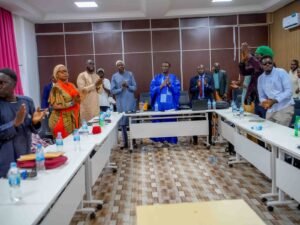 In a conciliatory tone, Bensuda also extended a hand to political actors who participated in the coalition process but are not currently part of the alliance.
“The door remains open,” he said. “There is room in this national project for every Gambian who believes that our country deserves a better future.”
That message of openness will be important if Coalition 2026 hopes to move from internal selection to broad national appeal. Coalitions often succeed not only by naming a candidate, but by managing egos, harmonizing programs, respecting partners and convincing citizens that unity is more than an electoral arrangement.
Bensuda said the campaign should now move beyond individual contenders and focus on one coalition, one program, one candidate and one national mission.
“From this moment, the campaign is no longer about individual contenders,” he said. “It is about one coalition, one programme, one candidate and one national mission.”
His closing message emphasized humility, discipline, unity and restraint.
“Let us go forward with humility. Let us campaign with discipline. Let us unite without hatred. Let us win without arrogance. And let us govern without revenge,” Bensuda said. “The Gambia comes first.”
 For many Gambians, the deeper test of Coalition 2026 will be whether it can translate political unity into a credible national program addressing jobs, youth opportunity, governance, public accountability, cost of living, environmental protection, public services and institutional reform.
Coalition politics in The Gambia carries both promise and risk. It can bring divided forces together around national rescue and democratic renewal. But it can also collapse under mistrust if partners are not treated fairly or if the coalition becomes only an election vehicle without a clear governing vision.
Bensuda’s acceptance speech therefore sets a tone of inclusion and discipline. The challenge now is implementation: building trust within the coalition, communicating clearly with citizens and proving that political unity can produce practical solutions for ordinary Gambians.
If Coalition 2026 keeps national interest at the center, its campaign could become a platform for constructive political competition. If it allows personal ambition and internal rivalry to dominate, it risks disappointing citizens who are looking for serious leadership, not another cycle of political fragmentation.
About The Author