Gambia strengthens regional leadership on missing migrants
By Ebrima Fadera
Edited by Mutiu Olawuyi
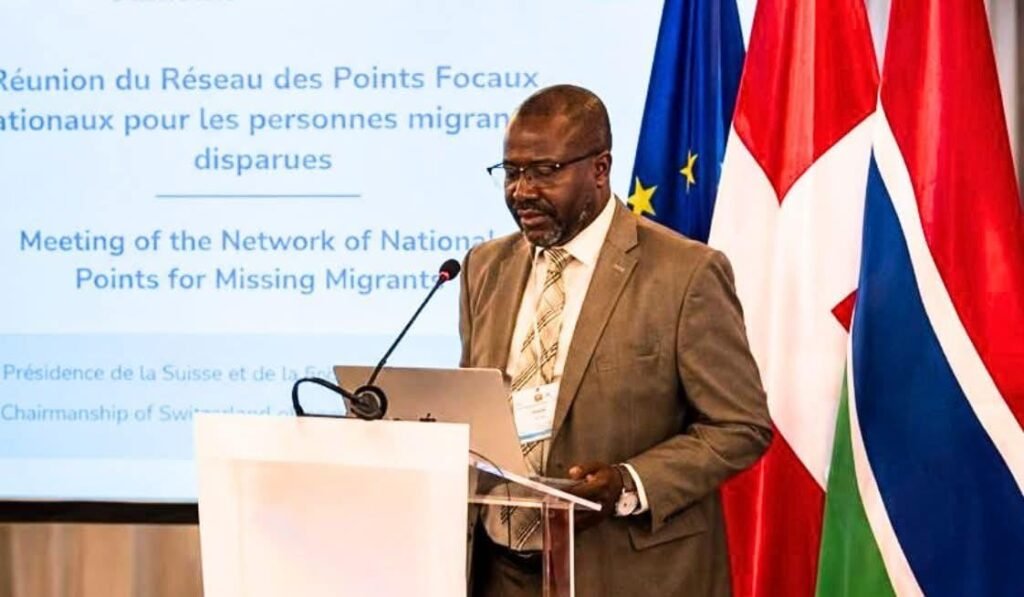
The Gambia has reinforced its growing role in regional migration governance by co-chairing the second in-person meeting of the Network of National Focal Points for Missing Migrants under the Rabat Process, alongside Switzerland.
The two-day meeting, held in Geneva from June 24–25, 2026, followed the successful conclusion of The Gambia’s nationwide Regional Consultations on Missing Migrants in Banjul and marked another step in the country’s efforts to promote coordinated, humane and family-centered responses to one of migration’s most pressing humanitarian challenges.
The Gambian delegation participated under the leadership of the Ministry of Foreign Affairs, International Cooperation and Gambians Abroad (MoFA), building on consultations that brought together government institutions, security services, traditional leaders, civil society organizations, community representatives and development partners to examine the growing challenge of missing migrants.
Those national consultations explored practical measures to strengthen prevention, improve emergency response mechanisms and enhance coordination among institutions responsible for migration management.
The Geneva meeting expanded that national conversation onto the regional stage.
Working alongside Switzerland, The Gambia led discussions among Rabat Process partner countries on ways to strengthen regional cooperation in preventing migrant disappearances, improving cross-border information sharing, enhancing tracing and identification systems, and ensuring that affected families remain at the center of every response.
The meeting was supported by the International Committee of the Red Cross (ICRC), which serves as the Secretariat of the Network of National Focal Points for Missing Migrants.
Participants also examined practical measures for translating political commitments into operational action through stronger cooperation among governments, humanitarian organizations and forensic experts. Discussions focused on improving case referrals, strengthening identification processes and expanding support services for families searching for missing relatives.
Migration remains one of the defining issues facing West Africa. Thousands of migrants leave the region each year in search of safety, education, employment and better opportunities. While many complete their journeys successfully, others disappear along migration routes, leaving families with unanswered questions and years of uncertainty.
For those families, the greatest burden is often not knowing whether a loved one is alive, injured or deceased. The absence of reliable information can prolong emotional trauma and complicate legal, social and economic decisions.
 By placing families at the heart of the discussion, the Rabat Process meeting recognized that migration governance is not only about border management. It is also about protecting human dignity, preserving family unity and strengthening cooperation across countries that share responsibility for migration routes.
The Gambia’s role as co-chair reflects the country’s increasing profile in regional migration diplomacy and its willingness to contribute practical solutions to complex humanitarian challenges.
The country’s experience in convening inclusive national consultations has demonstrated the value of bringing together government agencies, local communities, security institutions, traditional authorities and civil society to address migration-related concerns collectively.
That whole-of-society approach was echoed in Geneva, where participants agreed that preventing migrant disappearances requires stronger institutional coordination, better information systems and closer cooperation between neighboring countries.
Beyond improving tracing mechanisms, the discussions highlighted the importance of prevention. Expanding public awareness, strengthening legal migration pathways, addressing trafficking risks and improving community engagement can reduce the circumstances that leave migrants vulnerable to disappearance.
The meeting also underscored the importance of regional solidarity. Missing migrant cases often cross multiple jurisdictions, making international cooperation essential for locating missing persons, identifying remains where necessary and providing timely information to families.
For The Gambia, continued engagement through the Rabat Process reinforces its commitment to working with regional and international partners to build migration systems that are both effective and compassionate.
As migration continues to shape the lives of families across West Africa, initiatives that strengthen cooperation, improve accountability and place human dignity at the center of policy will remain critical to building safer migration pathways and restoring hope for families searching for missing loved ones.
About The Author