Editorial | America First in Africa: Opportunity, Warning and the Test of African Leadership
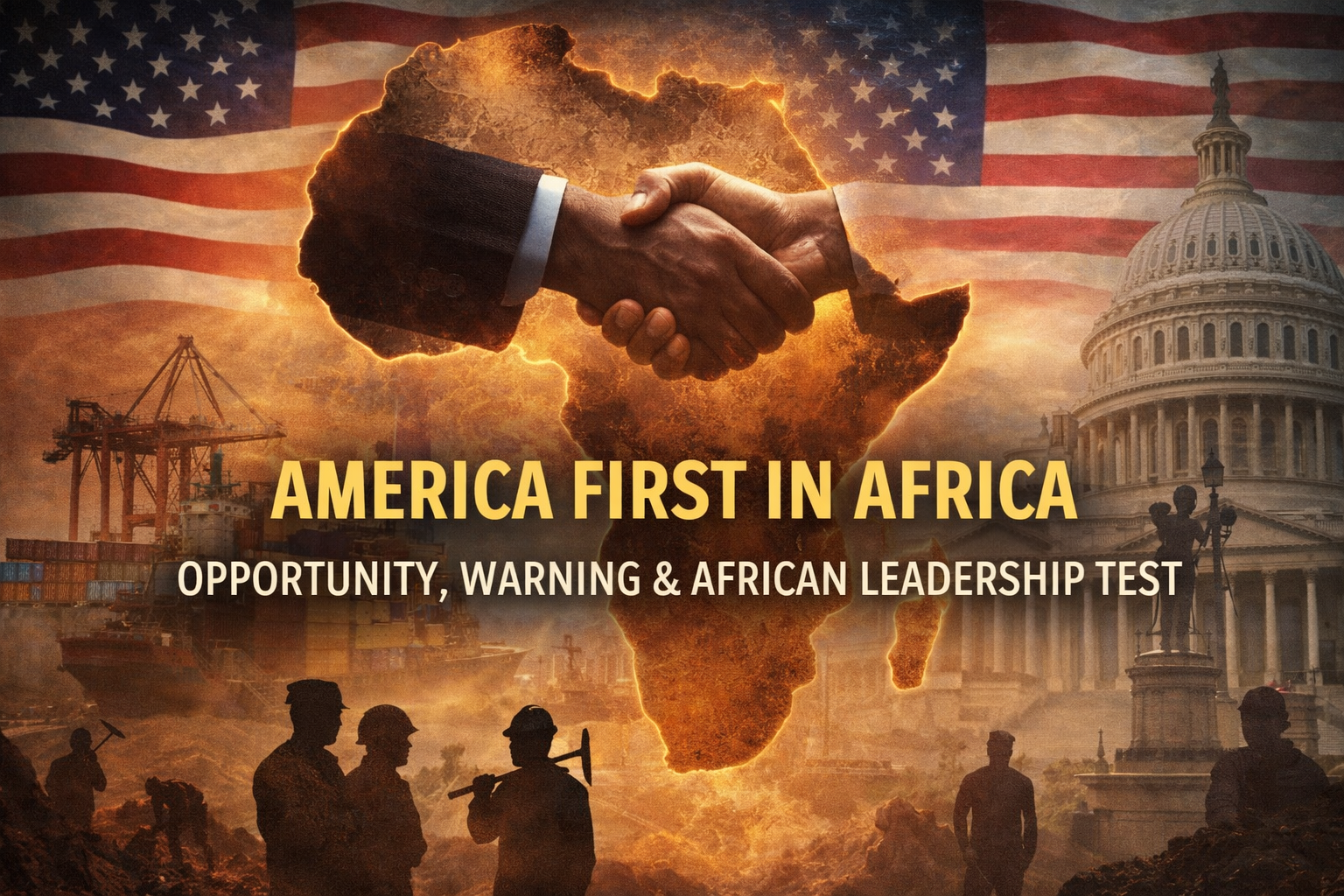
The United States has now said plainly what many African leaders, diplomats and analysts have long suspected: Washington’s relationship with Africa is entering a harder, more transactional, and more openly strategic phase.
In a major policy speech, senior U.S. officials under the Trump administration declared that the era of “aid-first” engagement is giving way to a new doctrine of “trade, strategic interest, critical minerals, commercial diplomacy, and burden-sharing.” The message was clear: America still wants Africa—but this time, it wants Africa on terms that are more directly aligned with American national interests.
For Africa, and particularly for countries like Senegal, The Gambia, and others across West Africa, this shift should not be met with panic, sentiment, or applause alone. It should be met with clarity.
Because while there is real opportunity in this new posture, there is also real danger.
The End of Illusions
Let us begin with honesty.
The old aid relationship between Africa and much of the West has never been as noble or as balanced as it was often presented. Too often, “development partnership” became a polite mask for dependency, donor control, NGO overreach, elite capture, and political patronage. Too often, African governments learned how to receive, report, workshop, and survive—without truly transforming.
So when Washington now says it wants to move from aid to trade, many Africans will understandably say: Good.
And in principle, they are right.
Africa does not need to be permanently managed as a humanitarian burden. It needs to be respected as a continent of markets, minerals, ideas, labor, logistics, energy, and human potential. It needs roads, ports, electricity, processing zones, manufacturing, industrial policy, and serious investment—not endless conferences about empowerment while unemployment grows and public frustration deepens.
If the new U.S. posture means more infrastructure, more private investment, more supply-chain partnerships, and more commercial dignity, then Africa should welcome that conversation.
But only if Africa enters that conversation with its eyes open.
Trade Is Better Than Aid — But Exploitation Can Wear a Suit
There is a dangerous assumption hidden inside the phrase “trade not aid”: that trade is automatically fairer than aid.
It is not.
Trade without negotiating strength can become extraction by another name.
When global powers compete for Africa’s cobalt, lithium, rare earths, gas, ports, energy corridors, and strategic geography, the continent must ask a basic question: Who is really benefiting?
Will Africa once again export raw value and import finished dependency?
Will the minerals leave, the profits leave, the processing happen elsewhere, and the jobs remain scarce?
Will African governments sign deals they do not fully understand, under pressure they do not publicly admit, in exchange for short-term elite gains and long-term structural weakness?
That is the real issue.
America’s new policy is not inherently anti-African. But it is explicitly pro-American.
And that means African leaders must now decide whether they will be merely available—or strategically prepared.
Africa Must Stop Negotiating as a Collection of Beggars
This moment should be a wake-up call to African governments and regional blocs.
The continent cannot continue to negotiate with the world as fragmented, vulnerable, reactive states each seeking a separate handshake from Washington, Beijing, Brussels, Ankara, Moscow or the Gulf.
That model weakens Africa.
It is time for stronger continental bargaining, stronger regional industrial planning, stronger value-addition policies, and stronger insistence that if the world wants Africa’s resources, then Africa must receive not just royalties, but processing capacity, technology transfer, workforce development, and local ownership.
This is where institutions like ECOWAS, the African Union, and regional trade blocs must prove they are more than ceremonial architecture.
Because if Africa cannot negotiate collectively in an era of global competition, then it will simply be divided more efficiently.
What This Means for Senegal and The Gambia
For countries in the Senegambia region, this new American posture should be read both as an opportunity and a warning.
Senegal, with its energy potential, strategic Atlantic location, political visibility, and growing regional relevance, will likely attract more attention under this framework. The Gambia, though smaller, also sits within a subregional space that matters for migration, trade, democratic signaling, and coastal strategy.
But attention is not the same as advantage.
If these countries are to benefit, they must build the domestic foundations that make partnership meaningful:
credible institutions, transparent procurement, accountable leadership, skilled labor, industrial readiness, anti-corruption enforcement, and policy continuity.
Without those, “partnership” becomes performance. Deals will be announced. Headlines will be celebrated. But the ordinary citizen will still ask the same question five years later:
What changed for us?
That is the standard by which all foreign policy must be judged—not by diplomatic smiles, but by public outcomes.
The Quiet Retreat from Democracy Language
Another part of the U.S. message should not be ignored.
Washington has made clear that it now prefers engaging governments “as they are,” with less public emphasis on democratic norms and more focus on security, migration, minerals, and commercial access.
Some African leaders may welcome that.
But African citizens should be careful.
Because when powerful nations stop publicly caring about governance, transparency, rights and accountability, local elites often become more comfortable with opacity, patronage and impunity.
Africa must not outsource democracy to the West—but neither should it celebrate when global powers decide that democratic standards are optional.
The defense of accountable governance must now come more urgently from within Africa itself: from journalists, civil society, courts, reformers, scholars, students, and citizens who still believe that sovereignty without accountability becomes elite enclosure.
The Real Question Is Not What America Wants — It Is What Africa Wants
This is the question African governments must answer now, with seriousness:
What is our own long-term strategic vision?
Not America’s vision. Not China’s. Not Europe’s. Not the IMF’s.
Ours.
Do we want to remain commodity exporters or become industrial economies?
Do we want migration crises or youth opportunity?
Do we want political slogans or public systems that work?
Do we want to be courted by the world—or respected by it?
Because no foreign power, however influential, can answer those questions for us.
The tragedy of African diplomacy has often been this: we react brilliantly to the agendas of others while failing to define our own.
That must end.
A Moment of Choice
The Trump administration’s “America First in Africa” strategy is not the end of Africa’s future. It is a mirror.
It reveals, with unusual bluntness, how the world increasingly sees the continent: not as a charity case, not as a moral project, but as a strategic arena.
That is not entirely bad.
But it means the burden now falls more heavily on African leadership.
If Africa approaches this moment with discipline, confidence and strategic intelligence, it can extract real value from this new global attention.
If it approaches it with vanity, fragmentation and elite short-termism, it will once again be used—this time under more commercially sophisticated language.
The era ahead will not reward weakness dressed as diplomacy.
It will reward countries that know what they want, what they are worth, and what they are no longer willing to give away cheaply.
Africa should welcome partnership.
But it must stop arriving at the table unprepared.
Mutiu Olawuyi
Chief Editor
Senegambia Times
About The Author