



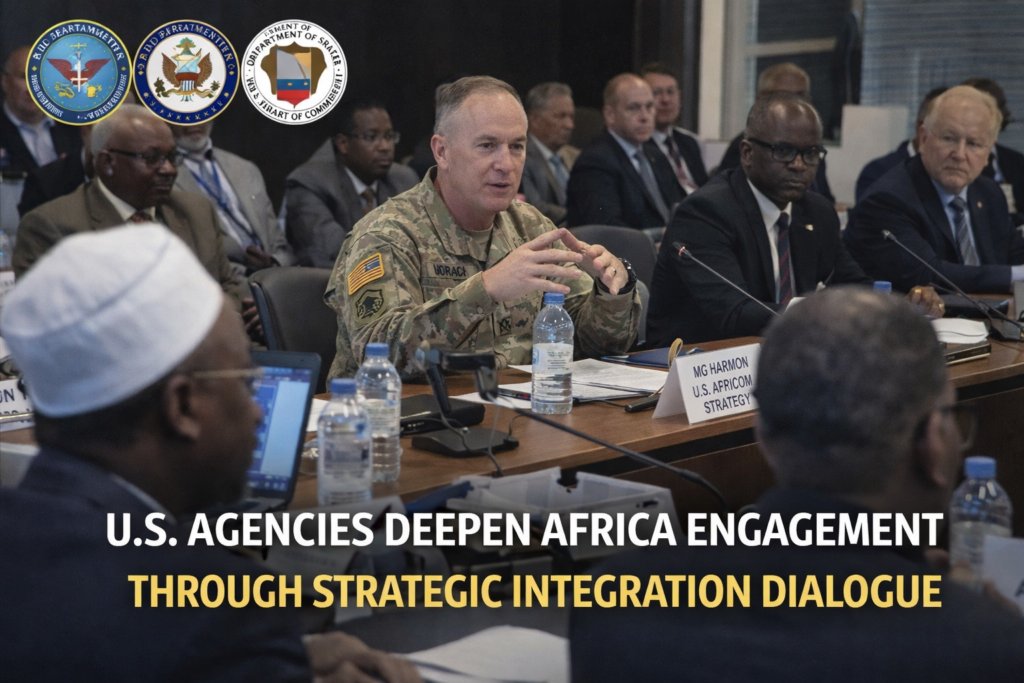
More than 160 officials from key United States government agencies convened this week for the Africa Strategic Integration Dialogue, a high-level forum aimed at strengthening coordination across diplomacy, security, and economic development efforts on the African continent.
Participants drawn from the U.S. Departments of Defense, State, and Commerce explored how a more integrated, interagency approach can better align investment, development priorities, and security strategies in Africa. The dialogue reflects a growing recognition that long-term stability on the continent depends not only on security interventions, but also on sustainable economic growth and effective governance partnerships.
Major General Garrick Harmon, Director of Strategy at United States Africa Command, emphasized the importance of bridging strategic planning with practical implementation. He noted that the forum enables stakeholders to engage across multiple levels of decision-making, ensuring that coordination translates into real-world impact.
The dialogue signals a shift toward more holistic engagement—one that views Africa not solely through a security lens, but as a critical partner in global economic and geopolitical stability. By aligning commercial diplomacy, infrastructure investment, and development initiatives with security frameworks, policymakers aim to address root causes of instability, including unemployment, weak institutions, and limited economic opportunities.
For African stakeholders, such coordination presents both opportunity and responsibility. While increased collaboration can unlock investment, strengthen supply chains, and support local capacity-building, its success will depend on how effectively partnerships are grounded in mutual benefit, transparency, and respect for national priorities.
The forum also underscores a broader trend in international engagement with Africa: moving from fragmented interventions toward integrated strategies that recognize the interconnected nature of development, security, and economic resilience.
As global competition for influence and resources intensifies, dialogues like this may play a pivotal role in shaping how Africa’s partnerships evolve—ideally toward outcomes that promote shared prosperity, regional stability, and long-term peace.


More Stories
Three arrested in Kaolack livestock theft bust
Senegal’s First Lady joins Global Child-Welfare Summit in Washington
Ghana applauds UN backing of landmark resolution on slavery as crime against humanity