From Memory to Moral Courage: Sharaka’s 2026 March of the Living Delegation Seeks to Turn Holocaust Remembrance into Peacebuilding
A diverse international delegation—including interfaith leaders, journalists, and educators—will travel to Poland not only to remember the Holocaust, but to return home with a renewed mission of tolerance, dialogue, and human dignity.
At a time when the world is increasingly fractured by suspicion, hate, and identity-based division, a new international delegation is preparing to walk into one of history’s darkest chapters—not to remain in its shadows, but to bring back light.
This April, Sharaka’s 2026 March of the Living Delegation will travel to Poland for a carefully designed Holocaust education and remembrance journey that blends historical witness, interfaith dialogue, and restorative peacebuilding. According to the official brochure, the program offers participants the opportunity to “learn about some of the darkest moments in history” while building bridges, strengthening “moderate voices,” and carrying lessons of remembrance into their own communities.
This is not simply a memorial trip. It is a moral and civic project. Sharaka, an organization devoted to people-to-people diplomacy in the Middle East, says its mission is to build communities, educate, and facilitate deep engagement around the Abraham Accords. Through this program, it seeks to turn historical memory into public responsibility—particularly among leaders who can shape conversations in media, education, religion, and civil society.
In partnership with the Claims Conference, the program places Holocaust remembrance within a broader framework of ethical education. The brochure explains that participants will return home as “Ambassadors of Tolerance and Peace,” carrying insights meant to foster mutual respect, coexistence, and understanding in their societies.
That ambition matters deeply in today’s world. Memory, if left unshared, can become private sorrow. But memory, when engaged publicly and responsibly, can become a shield against future dehumanization.
A Journey Through Sites of Human Rupture
The delegation’s itinerary reflects both historical seriousness and emotional intentionality. Participants will begin in Kraków on April 13, with orientation sessions and a guided visit to Kazimierz, the historic Jewish quarter, to understand Jewish life in Poland before the Holocaust. That first day is designed not only to expose delegates to what was destroyed, but to what once flourished.
The following days will take participants to Auschwitz, Auschwitz-Birkenau, and the March of the Living, where remembrance becomes both physical and symbolic. Reflection workshops and group discussions are woven into the program, reinforcing that historical education is not complete without ethical reflection. The delegation will also visit Plaszow Concentration Camp before departure.
This is what makes the initiative especially relevant in a restorative framework: it does not ask participants merely to consume history, but to wrestle with it.
A Delegation of Bridge-Builders
The participant list itself tells a story of possibility. The delegation includes a broad range of Muslim, Arab, African, Jewish, and international voices—journalists, educators, civic leaders, peace advocates, and public thinkers who each carry influence within their own networks.
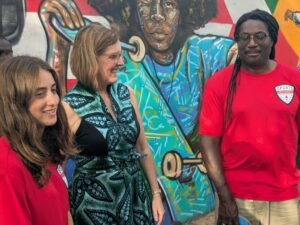
Among them is Sheikh Musa Drammeh, a Senegambian-Ameeican New York-based community leader and founder of the Muslim Media Corporation, who is recognized in the brochure for decades of work in interfaith dialogue, education, and social peacebuilding. Also participating is Shireena Drammeh, an educator and community builder whose work in the Bronx has long connected youth development with coexistence and interfaith engagement.
Their inclusion signals something important: this is not a closed memory space. It is a shared civic classroom.
Why This Matters in Africa and Beyond
For audiences in Senegal, The Gambia, and across West Africa, this initiative speaks to more than European history. It speaks to the universal danger of dehumanization, the fragility of social trust, and the moral cost of silence when prejudice hardens into policy and violence.
The question is not simply whether participants will be moved. It is whether they will become more useful to their communities after being moved.
If they return as better teachers, more responsible journalists, more courageous clergy, more thoughtful policymakers, and more empathetic citizens, then this journey will have done more than commemorate the past. It will have served the future.
A Living Reminder
The Holocaust remains one of humanity’s most devastating warnings. But remembrance alone is not enough. The true challenge is whether memory can still produce conscience in an age of outrage and indifference.
Sharaka’s 2026 March of the Living Delegation appears to be betting that it can.
And perhaps that is precisely what the moment demands.
About The Author