Sharaka to take interfaith leaders to Poland as 2026 March of the Living delegation
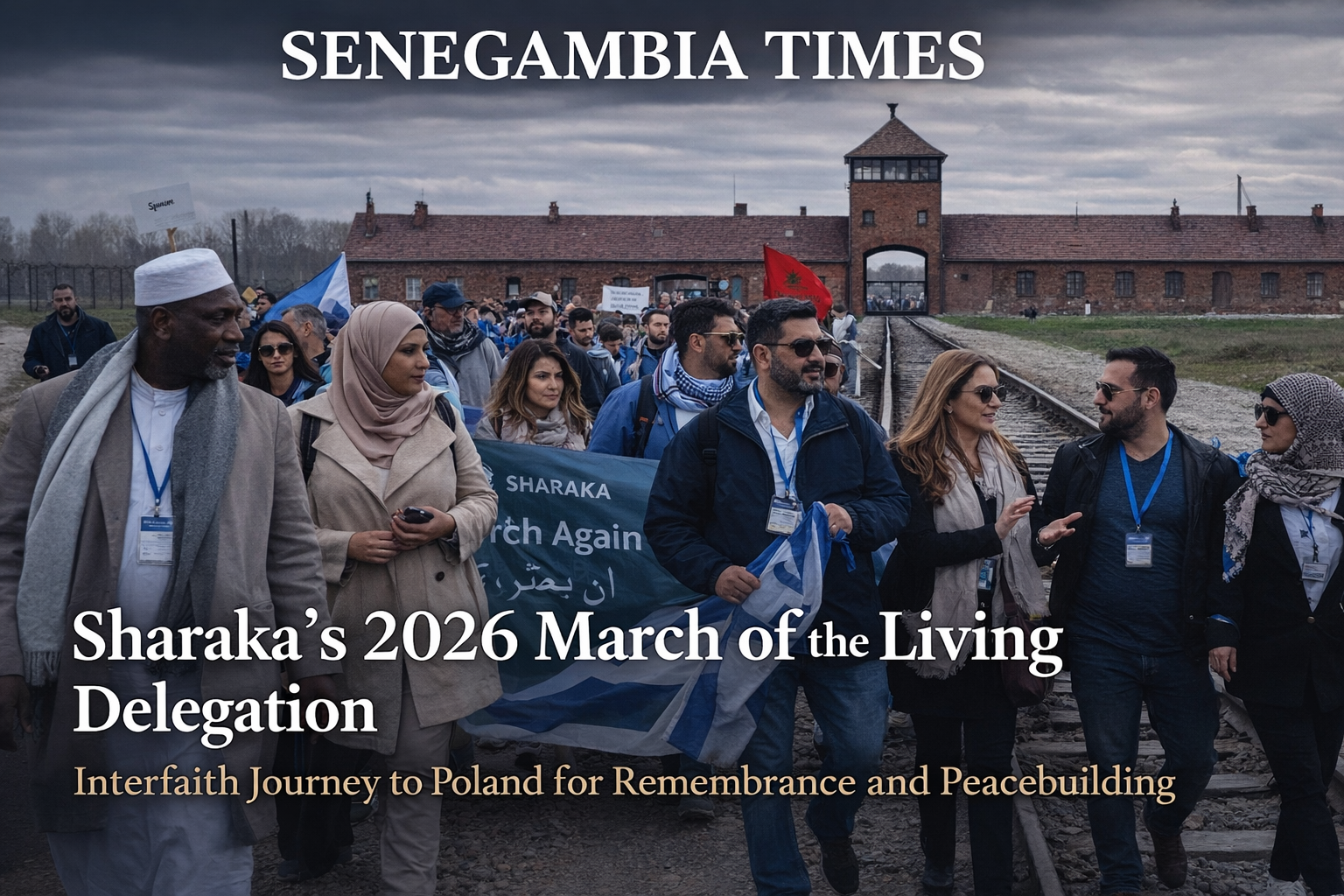
A new international delegation led by Sharaka is preparing to travel to Poland this April for the 2026 March of the Living, a Holocaust education and interfaith peacebuilding initiative that seeks to turn remembrance into responsibility and historical reflection into contemporary bridge-building. The organizer describes the program as a rare opportunity for participants “to learn about some of the darkest moments in history” while strengthening “the role of moderate voices in our societies” and promoting “tolerance, remembrance, and coexistence.”
At its core, the initiative is not framed simply as a memorial visit, but as a values-driven educational journey. According to the organizer, participants from across the globe will engage in dialogue, social storytelling, and public-facing content creation designed to carry the lessons of the Holocaust beyond museum walls and into communities back home. The brochure explicitly encourages delegates to use social media and other channels to share what they witness, arguing that “your voice matters” and that participants can help “bring these lessons to a wider audience.”
From Memory to Moral Responsibility
Sharaka is an organization committed to people-to-people diplomacy in the Middle East, with a mission centered on building communities, education, and engagement around the Abraham Accords. In this context, the March of the Living delegation reflects a broader effort to create new spaces where Arab, Muslim, Jewish, and international participants can engage difficult history while modeling a future rooted in human dignity and coexistence. The brochure states that Sharaka’s mission is “to build communities, educate, and facilitate deep engagement” through its projects.
The initiative is being carried out in partnership with the Conference on Jewish Material Claims Against Germany (Claims Conference), an organization that represents world Jewry in negotiations for compensation and restitution for victims of Nazi persecution and their heirs. Beyond compensation, the brochure notes that the Claims Conference also supports Holocaust remembrance and education. Sharaka’s partnership with the organization is designed to provide participants with what it calls “a unique opportunity to learn about the Holocaust,” while helping them return to their countries as “Ambassadors of Tolerance and Peace.”
That language matters. In a world increasingly fractured by polarization, conflict, and identity-based suspicion, the delegation offers a model of restorative remembrance—one that does not ask participants merely to observe tragedy, but to wrestle with its implications for present-day pluralism, public ethics, and civic responsibility.
A Journey Through Sites of Memory
The delegation’s itinerary shows a carefully designed educational structure. Participants are scheduled to arrive in Kraków on April 13, where the program will begin with an opening session, group introductions, and a guided visit to Kazimierz, the historic Jewish quarter of Kraków, to explore Jewish life in Poland before the Holocaust. That evening includes dinner with members of the local Jewish community and community leaders.
On April 14, delegates will visit Auschwitz and participate in the March of the Living, followed by a reflection session and workshop. The next day, April 15, the group will undertake a guided visit to Auschwitz I and Auschwitz II-Birkenau, before taking part in additional reflection and an evening dinner at the Jewish Community Centre of Kraków with visiting groups from around the world. The program concludes on April 16 with a visit to Plaszow Concentration Camp before departures.
This structure reveals a notable pedagogical approach: not only exposing participants to historical sites of atrocity, but pairing those visits with dialogue, reflection, and community engagement. That combination is central to constructive and restorative journalism because it moves beyond “what happened” to ask: What should memory do to us? How should remembrance shape the kind of societies we build?
Diverse Delegation, Shared Responsibility
One of the most striking features of the delegation is the diversity of its participant list. The 2026 delegation includes journalists, scholars, educators, peace advocates, interfaith leaders, social media voices, and public thinkers from across the Muslim, Arab, African, and international worlds. Among them are Sheikh Musa Drammeh, a respected Senegambian-American New York-based community leader and founder of the Muslim Media Corporation and several interfaith and educational initiatives, including Muslim-Israel Dialogue. According to the organizer, his work has long focused on peacebuilding, social entrepreneurship, and helping communities grow “stronger through dialogue, education, and compassion.”
Also included is Shireena Drammeh, an educator and community builder who has worked for over two decades at the Islamic Leadership School in the Bronx, and who has developed interfaith programs with Jewish institutions. The brochure credits her with promoting peace, leadership, and youth empowerment.
Other participants listed include Pakistani journalist Ahmed Quraishi, UAE/Saudi linguistics advocate Loay Al Shareef, Israeli Bedouin educator Tamer Masudin, Moroccan cultural and diplomatic advocate Amine Drissi, Syrian-American journalist Hayvi Bouzzo, and a range of civic, religious, and professional leaders from Morocco, Pakistan, Azerbaijan, Israel, the United States, and Europe.
Taken together, the delegation reflects an intentional attempt to build cross-border moral literacy—a recognition that memory work becomes more meaningful when it is carried by people who can translate it into local conversations about dignity, prejudice, coexistence, and justice.
Why This Matters for Senegambia and West Africa
For audiences in Senegal, The Gambia, and the wider West African region, the significance of this initiative goes beyond European history. The Holocaust remains one of the clearest historical warnings about what happens when dehumanization becomes normalized, institutions fail morally, and communities stop seeing one another as fully human.
That lesson has profound relevance for African societies navigating religious diversity, political tension, youth frustration, migration anxieties, and rising global polarization. Programs like this suggest that historical education can be used not to divide communities into competing victimhoods, but to deepen shared responsibility for human protection.
The value of the delegation lies in what participants do after they return. If they become true ambassadors of remembrance and peace—as the organizer envisions—then the program could help seed difficult but necessary conversations in mosques, churches, synagogues, schools, media platforms, civic institutions, and community networks.
Beyond Commemoration
This delegation also raises an important challenge for media and civil society: remembrance should not be reduced to symbolism. It must produce ethical imagination. It must challenge hatred before it becomes normalized. It must help communities identify the early signs of exclusion, propaganda, and moral indifference.
In that sense, Sharaka’s 2026 March of the Living Delegation offers something more than a trip. It offers a test of whether remembrance can still function as a public good in a fragmented age.
For those participating, the real journey may begin not in Poland, but when they return home.
This story is not only about Holocaust remembrance. It is also about the deliberate cultivation of leaders who can turn painful memory into public empathy, interfaith courage, and civic responsibility. For West Africa and beyond, that may be one of the most urgent forms of peacebuilding available today.
About The Author